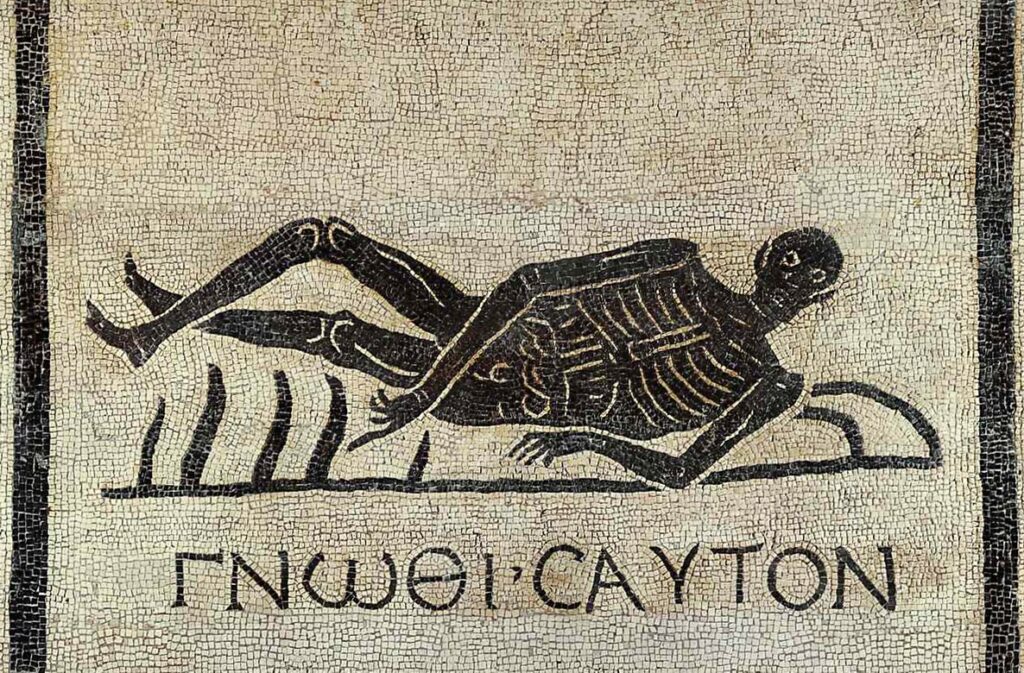

“Know thyself” was inscribed at the Temple of Apollo at Delphi, in ancient Greece.
Knowing who we are, how we relate to others, how empathetic we are and how we perform under stress is the foundation for understanding our real potential and aspirations, at work and in personal growth.
Sorting the countless nuances of the human mind into categories, or labeling them, has been the dream of great thinkers since antiquity. As far back as ancient Greece, the theory of the four temperaments tried to make certain features of the psyche easier to understand and predict. Summarizing a few traits to grasp others more quickly is a desire as old as humanity itself.
Today there are many tests based on the work of leading 20th-century psychologists and contemporary researchers. Used well, they describe a person’s main behavioral patterns and personality traits.
We tailor these tests to the individual and to the team, to bring out the differences between people and put them to good use. They come as single tests or as packages, depending on what you want to explore and how much depth you need.
What these tests can bring to light
- how a person takes in and processes information;
- what they base their decisions on;
- their degree of empathy;
- how they relate to others and work in a team;
- emotional intelligence (EQ);
- their main personality traits.
What they’re for
- recognizing everyone’s strengths and facing their weak spots;
- understanding relationships in the workplace, so that subgroups can be structured well.
The tests we offer
- Personality type, Jungian-derived, in the family of the Myers-Briggs Type Indicator® (MBTI®), the Keirsey Temperament Sorter® and the Montgomery temperament model.
- Emotional intelligence (EQ): how well a person empathizes with others and manages their own emotions and relationships. See Emotional intelligence.
- Big Five: the relative weight of five broad personality traits.
- VAK: preferred communication channels (visual, auditory, kinesthetic). Useful to start a conversation about preferences; research does not support the idea that people learn better when taught in their preferred channel.
- DISC: behavioral patterns across four broad areas.
- Mindset test, based on the work of Carol Dweck, professor of psychology at Stanford University: two broad attitudes toward the possibility of personal change.
For emotional intelligence we use the TEIQue. For an overview of another widely used family of EQ instruments, see Six Seconds.
These and other tests only become meaningful and useful when the results are analyzed one by one, in depth, and discussed with the person, so that the many shades of each of us come together into a realistic picture. Used this way, they are a solid starting point for targeted personal development.
Q&A
Why test with us?
Because we’re not tied to a single testing method. Interpretation is partly shaped by the method, so using several different ones helps us see more areas of a personality, more clearly and completely. Results stay between you and us: we don’t share them with anyone else (tests taken online are processed on the publisher’s own platform). A synoptic reading gives both the big picture and the detail.
Why are some questions repeated?
To reduce the statistical chance of error: the more items there are, the smaller the impact of misreading one or two questions.
Can the results be faked?
In principle, anyone can answer the way they’d like to be seen, and no self-report questionnaire can fully prevent it. But there are no right or wrong answers, so there’s little to gain: honest answers give the most useful picture.
Are the results reliable?
It depends on the instrument. The Big Five model and the TEIQue have strong research support; type-based tools in the MBTI family are widely used in organizations but have weaker evidence of consistency over time. That’s why we use all of them as a starting point for conversation, never as fixed labels.